
Syrians are returning because the fall of the Assad government in December 2024 removed the main reason most of them fled. Many want to be back with family, land and a place where they belong. At the same time, life in host countries like Turkey has become harder and less certain. Most go back to damaged homes and thin services, so return is often slow, partial and fragile.
For more than ten years, our team has worked alongside displaced families in İzmir, from the informal settlements around Torbalı to our community centre in Basmane. Since December 2024, one question has come up in almost every conversation we have with Syrian families: should we go back?
It is not a simple question, and the families asking it are not waiting for anyone to answer it for them. They are comparing rents and school calendars, phone calls from cousins in Aleppo and Idlib, and photos of houses that may or may not still have a roof. This article puts what the research says next to what we see every week on the ground.
How Many Syrian Refugees Have Returned?
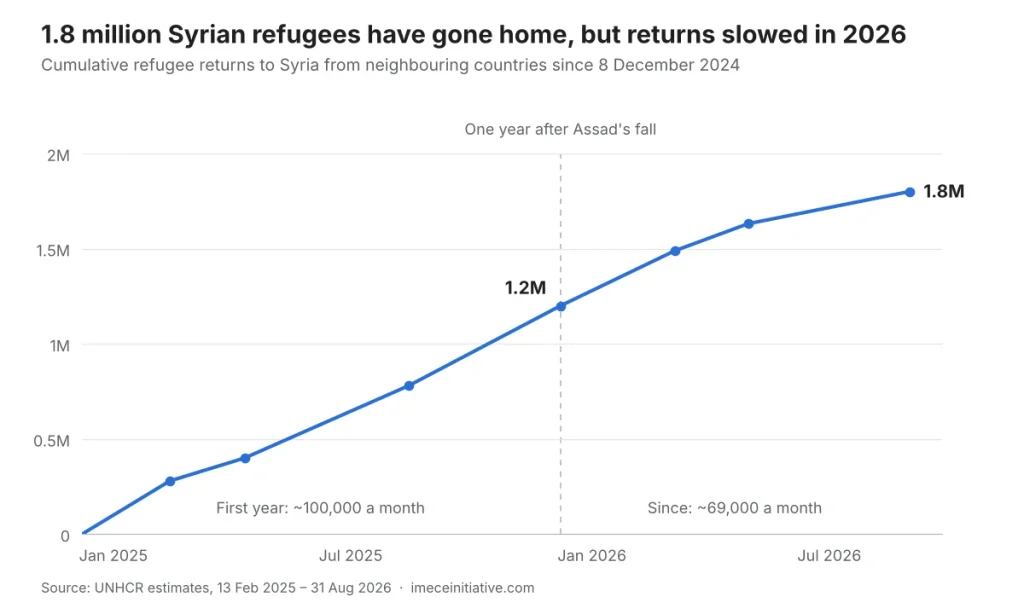
Around 1.8 million Syrian refugees returned from neighbouring countries between 8 December 2024 and 31 August 2026, according to UNHCR, alongside more than 2 million people displaced inside Syria who went back to their home areas (UNRIC).
Turkey accounts for the largest share. By the end of April 2026, about 41% of refugee returnees had come from Türkiye (Refugees International). In October 2026, Turkey’s Interior Minister put the number who had gone back from Turkey since 8 December 2024 at roughly 723,000 (Enab Baladi).
Still, about 2.2 million Syrians remain under temporary protection in Turkey. For the full breakdown, and why different sources give different numbers, read our guide to how many refugees are in Turkey in 2026.
The Pull: Why Families Want To Go Home
The Fear That Made People Leave is Gone
For most Syrians we know, the war was never only about bombs. It was about arrest, disappearance and the fear of a knock at the door. When that system collapsed, the biggest barrier to going home went with it.
Muhammed Zeyn, an Oxford researcher from Aleppo, argues that dignity and belonging explain the scale of return better than any checklist of housing and services (COMPAS). Returnees posting online described crossing the border as “the return of the soul to the body.” After fourteen years of being called refugees, many simply wanted to be Syrian again.
Family, Land and a House That is Still Theirs
Some people are going back to hug parents and siblings they have not seen for a decade. Others go to protect what they own. Property records were lost or destroyed, and some homes were occupied or even sold on forged papers while their owners were abroad. A claim is easier to defend in person, so someone in the family often goes first (Refugees International).
Most people return to the exact places they left. IOM data show that 92% of people arriving from abroad went back to their areas of origin, mainly Idlib, Aleppo and rural Damascus (Refugees International).
A Country Slowly Reopening
Sanctions have eased and Syria has restored relations with many countries. In September 2026, the UN’s humanitarian chief told the Security Council that better security, eased sanctions and resilient communities were driving the recovery (UNRIC). For families who have followed every headline for years, that signal matters.
The Push: Why Life in Turkey Has Become Harder
Pull factors explain why people want to go. Push factors often explain when. Researchers looking at Lebanon and Jordan found that many Syrians were returning less because Syria had become safe and more because exile had become harder (The Conversation, via Naharnet). Turkey has its own version of this story.
The Cost of Living
Years of high inflation hit refugee families hardest. Most Syrians in Turkey work informally, in textiles, construction, farming and services, often for long hours and below the minimum wage. Rents in big cities have climbed fast. When rent eats most of a month’s wages, a family house in Syria, even a damaged one, can start to look like the only way to stop falling behind.
Rules That Keep Changing
Free health coverage for Syrians under temporary protection was scaled back from 1 January 2026, with many now expected to pay premiums like Turkish citizens (Daily Sabah). Officials have also discussed replacing temporary protection with a residence-permit system tied to housing, work, income and insurance (Daily Sabah).
Not every change pushes the same way. In June 2026, Turkey exempted people under temporary protection from needing a separate work permit (Arab News). But for families who have built a life here over ten years or more, not knowing what next year’s rules will be is a weight of its own.
Registered in One City, Living in Another
This is the reality we work with every day. Temporary protection gives access to schools and hospitals only in the province where a person is registered. Many families we support came to İzmir for seasonal farm work or cheaper rent and cannot re-register here. Their children cannot enrol in school, and a hospital visit becomes a problem.
For these families, staying can feel like no choice at all. Going back can look like the only way to get papers, schooling and health care in order again.
Less Aid, Everywhere
Humanitarian funding has fallen sharply. The World Food Programme halved its emergency food assistance inside Syria in May 2026, and in April it stopped general food aid for about 135,000 Syrian refugees living in Jordan’s towns and cities (Refugees International). Small organisations like ours feel the same squeeze. When the safety nets in exile get thinner, the pressure to decide grows.
Why So Many Families Return in Summer
In Turkey, the school calendar decides the timing. Turkish officials expected families with children in Turkish schools to wait for the academic year to end (Hürriyet Daily News), and in 2025 daily crossings rose to about 2,500 once schools closed on 20 June (Daily Sabah).
The effect shows up in classrooms. Refugee student enrolment in Turkey fell 14.1% at the start of the 2025–26 school year, from 871,824 to 749,362 (EU Support to Refugees in Türkiye).
Why Many Syrians Are Staying, For Now
Fewer refugees now plan to go back soon. In UNHCR’s regional survey of Syrians in Egypt, Iraq, Jordan and Lebanon, the share intending to return within twelve months fell from 27% in January 2025 to about 14% by April 2026 (Refugees International). Turkey had planned for 700,000 voluntary returns in 2026; its 2027 budget expects far fewer and sets a target of 110,000 for 2027 (Enab Baladi).
These are the reasons families give for waiting:
- Homes destroyed or unaffordable. More than 1.3 million housing units are damaged or destroyed. Monthly rents in Damascus can reach $500–1,000, above Istanbul, and landlords often want a year in advance (Refugees International).
- No power, few jobs. In an IRC survey of 425 returnees, 9 in 10 found water, electricity or health care missing or inadequate, and 71% were living in damaged housing (IRC). Electricity bills of $50–167 a month come close to an average salary, so families turn to solar panels and batteries (Refugees International).
- Unexploded ordnance. At least 2,375 people, including more than 850 children, have been killed or injured by explosive remnants of war since December 2024 (Refugees International).
- Children who learned in Turkish. Kids who grew up in Turkish classrooms often struggle with the Syrian curriculum, and many parents wait until a child finishes a school stage or a degree.
- Safety and an unfinished transition. In a December 2025 survey of Syrians in Türkiye, about 69% raised safety concerns about return, including kidnapping and weak law enforcement (Baker Institute).
- A door that opens one way. Returning ends temporary protection, and Turkish visas for Syrians are issued only in limited cases, so few could come back if things went wrong (Refugees International).
- What women stand to lose. For many women, going back can mean giving up income, independence and the support networks they built in exile. Some families split: the father stays in Turkey to earn while the mother and children go, or the other way around.
Returning is a Process, Not a Single Journey
Crossing the border is the easy part. In the IRC survey, 44% of returnees found conditions worse than they had expected, and only 18% said they had adequate support for the journey itself (IRC). UNHCR’s return cash is usually a single payment of about $100–300 per person (Refugees International), which does not go far against a year of rent.
Some returnees end up displaced again inside Syria. The families who manage best are the ones who go back with some savings, a skill people will pay for, and a realistic plan for the first year.
What This Means for Our Work in İzmir
We do not tell families whether to stay or go. That decision belongs to them, and it should be informed, voluntary and safe. What we can do is help them make it from a position of strength, whichever way they choose.
For families who are staying, the needs have not gone away. We keep distributing emergency aid such as food packages, hygiene kits and stoves in informal settlements, and we keep children learning through our Back to School programme and weekly activities in Basmane, regardless of nationality or legal status.
For families preparing to return, we created the Back to Home programme. Syrian women train in basic home electricity, solar installation, carpentry and home repair, and sustainable agriculture, while their children join language, psychosocial and art workshops. These are exactly the gaps returnees describe: no power, damaged homes, no income.
Back to Home grows out of our Solar Age Project, where refugee women, our “Solar Ladies”, learn to build and install solar systems. We have written about why clean-energy skills change women’s futures and why women’s education strengthens whole families. In a country where the grid is unreliable and electricity bills rival a salary, a woman who can wire a house and install a panel brings home more than a certificate.
How You Can Help
Whatever happens next in Syria, families here and families going home both need steady support. Small, regular gifts let a grassroots team like ours plan classes and training months ahead.
- Become a monthly donor and help fund training, school supplies and emergency aid.
- Volunteer with us in İzmir, or help from home through Imece Germany, Imece France or our knitting network.
- Share this article with someone who asks why Syrians are going home. The honest answer is more human than most headlines.
Frequently Asked Questions
Why are Syrian Refugees Returning to Syria?
Mainly because the Assad government fell in December 2024, removing the threat that made most people flee. Family ties, property and a sense of belonging pull them home, while rising costs, uncertain legal status and shrinking aid in host countries push them to decide sooner.
How Many Syrian Refugees Have Returned from Turkey?
Turkey’s Interior Ministry said about 723,000 Syrians had returned from Turkey between 8 December 2024 and October 2026. UNHCR counted about 640,000 by the end of April 2026. Around 2.2 million remain under temporary protection.
Is It Safe for Syrian Refugees to Return?
It depends on the area. Security has improved in many places, but there have been outbreaks of violence in some regions, unexploded ordnance remains widespread, and basic services are weak. UNHCR’s position is that every return should be voluntary, safe, dignified and sustainable.
Why Do Most Returns from Turkey Happen in Summer?
Families wait for the Turkish school year to end in June so their children can finish the year and take their documents with them. Daily border crossings rise sharply after schools close.
Why Are so Few Syrians Returning from Germany and Europe?
They have more to lose. Of roughly one million Syrians in Germany, only about 4,000 had permanently returned by May 2026, compared with about 1.6 million returns from neighbouring countries over the same period. Many hold long-term residency or citizenship and have children in school.
Can Syrians in Turkey Visit Syria and Come Back?
In general, returning ends temporary protection, and Turkish visas for Syrians are only issued in limited cases. Rules change often, so families should check with Turkey’s Presidency of Migration Management or UNHCR Türkiye before travelling.
Sources
- UNRIC: Syrian refugees return home as humanitarian needs persist (Oct 2026)
- Refugees International: Ten Challenges to Syrian Refugee Returns (15 Oct 2026)
- Enab Baladi: Turkey lowers forecast for Syrian returns in 2026 (Oct 2026)
- COMPAS, University of Oxford: Beyond safety and necessity (22 May 2026)
- IRC: Home, but Not Whole (6 Jul 2026)
- Baker Institute: The Evolving Protection Landscape for Syrian Refugees in Türkiye (Oct 2026)
- Turkish Minute: 640,000 Syrians have returned from Turkey (UNHCR) (4 May 2026)
- EU Support to Refugees in Türkiye: Education brief (Jun 2026)
- Daily Sabah: Türkiye takes new steps to encourage returns · Syrian population declines 38.5% in 5 years · Returnees exceed half a million
- Hürriyet Daily News: Türkiye expects surge in returns during summer
- Arab News: Voluntary return of 1.5m Syrians since 2016 (27 Jun 2026)
- Naharnet (The Conversation): Syrian refugees return home as Lebanon faces hardship (5 Dec 2025)
- Chart data: UNHCR Syria data portal (13 Feb 2025) · UNHCR briefing (11 Apr 2025) · UNHCR Canada (14 Aug 2025) · UNHCR press release (8 Dec 2025) · UNHCR dashboard (5 Mar 2026) · UNHCR dashboard (30 Apr 2026)
Update log — 2 Nov 2026: first published. We review this page every quarter. Have a newer figure or a correction? Contact us.
