
The Current Number
As of September 3, 2026, Turkey hosts approximately 2.22 million Syrians under temporary protection (2,218,101), according to Turkey’s Presidency of Migration Management (PMM) — down from a 2021 peak of 3,737,369. Including Syrians with residence permits (83,392, April 2026) and those who have naturalized since 2011 (240,915, Nov 2025), the total Syrian-origin population connected to the displacement crisis is closer to 2.54 million.
That’s a separate figure from Turkey’s total refugee population: adding roughly 150,000–230,000 refugees and asylum seekers of other nationalities to the temporary-protection Syrian count puts that number at around 2.37–2.45 million — still one of the highest totals of any country, even as it continues to fall.
The short version: Turkey’s Syrian refugee population has dropped by roughly 41% in five years, driven almost entirely by a wave of voluntary returns following the fall of the Assad government in December 2024.
Key Figures at a Glance
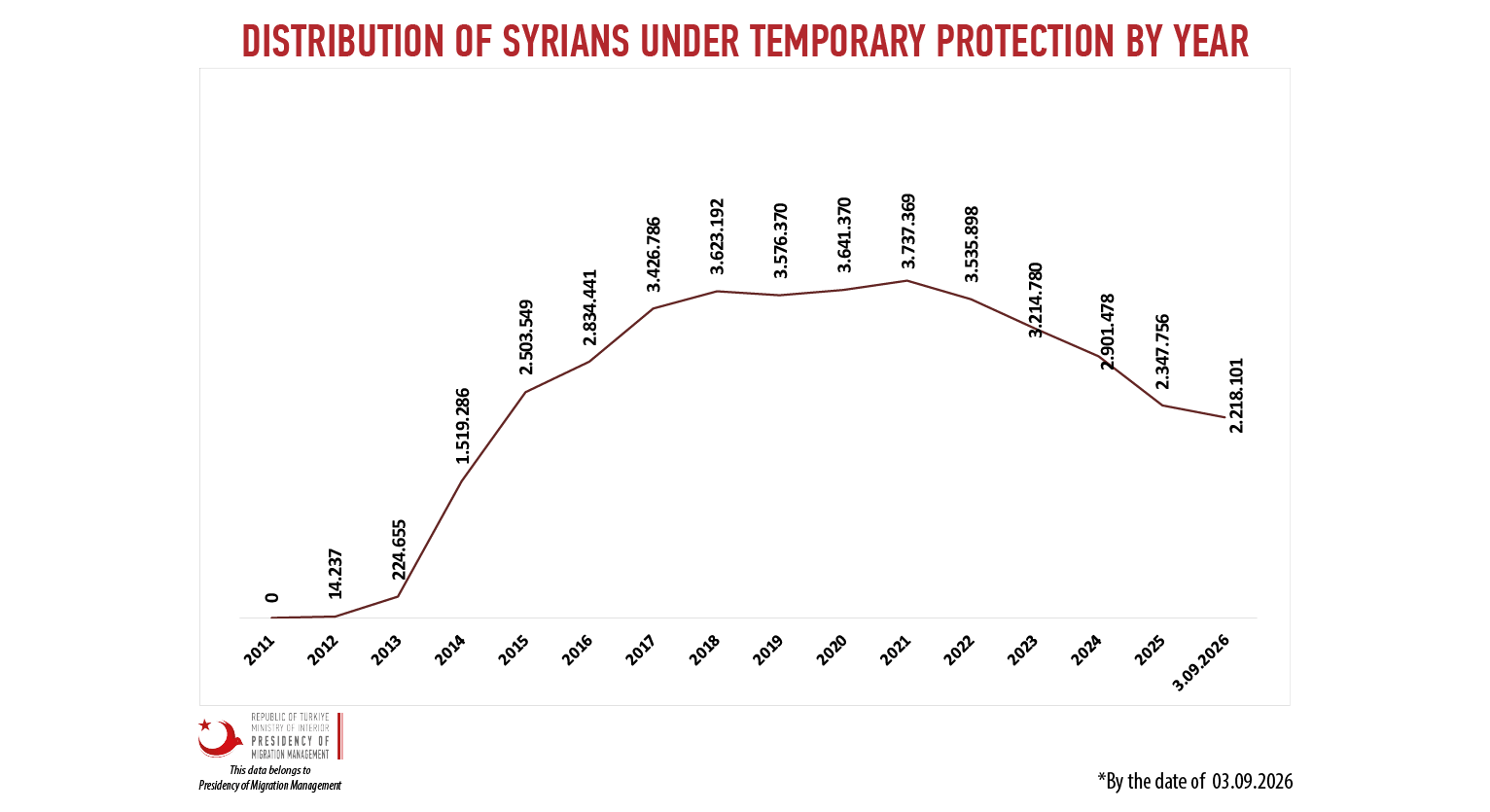 Image Source: Presidency of Migration Management (PMM).
MetricFigureAs of Syrians under temporary protection (PMM) 2,218,101 3 Sep 2026 Syrians with a residence permit (non-refugee status) 83,392 April 2026 Syrians naturalized as Turkish citizens since 2011 240,915 Nov 2025 Total Syrian-origin population (all categories) ~2.54 million 2026 Refugees/asylum seekers of other nationalities ~150,000–230,000 2026 Total refugee population (TP Syrians + other nationalities) ~2.37–2.45 million 2026 Peak Syrian refugee population (for comparison) 3,737,369 2021 Syrians returned to Syria from Turkey since Assads fall ~640,000–715,000 Dec 2024–May 2026 5-year trend ↓ ~41% 2021→Sep 2026
The 2021–2026 Decline: What Happened
Turkey held the title of the world’s largest host of Syrian refugees for most of the past decade, with the registered population peaking at 3,737,369 in 2021. Since then, the number under temporary protection has fallen every year, according to PMM’s own published figures:
Year Syrians under temporary protection 2011 0 2012 14,237 2013 224,655 2014 1,519,286 2015 2,503,549 2016 2,834,441 2017 3,426,786 2018 3,623,192 2019 3,576,370 2020 3,641,370 2021 (peak) 3,737,369 2022 3,535,898 2023 3,214,780 2024 2,901,478 2025 2,347,756 2026 (as of 3 Sep) 2,218,101
Source: Presidency of Migration Management (PMM), Republic of Turkey.
That’s a decline of roughly 41% since the 2021 peak — and it isn’t explained by a single cause. Births, new arrivals, and administrative reconciliation all play a role. But the dominant driver in the 2025–2026 numbers is a specific event: the collapse of the Assad government on December 8, 2024, which triggered the largest wave of voluntary Syrian returns since the crisis began.
According to UNHCR’s returns tracking, roughly 1.63 million Syrians have returned home from all host countries combined since Assad’s fall, and Turkish government and UNHCR figures put returns from Turkey
specifically at somewhere between 640,000 and 715,000 between December 2024 and mid-2026 (the range reflects the methodological differences explained below).
Turkish authorities have described the process as coordinated, with attention to accurate registration and orderly border crossings — though the scale and pace of it has been the single biggest factor reshaping the population figures over the past 18 months.
Why Sources Disagree
If you’ve searched around, you’ve probably noticed the number of “refugees in Turkey” isn’t consistent from one source to the next. That’s not sloppiness — it reflects real differences in what’s being counted and when. Here’s a side-by-side of the same metric (Syrians under temporary protection) pulled at different points in 2026:
Source Figure As of Notes PMM official chart (primary source) 2,218,101 3 Sep 2026 Most recent figure; used as this page’s headline number ECRE / Asylum Information Database (AIDA) 2,245,765 9 July 2026 Independent tracker citing PMM Wikipedia (citing PMM) 2,251,509 2 July 2026 Same underlying source, earlier pull date PMM (via secondary citation) 2,280,542 April 2026 Earlier in the year; superseded by the figures above UNHCR overview pages 2.3–3.2 million (varies by page) Inconsistent Different UNHCR pages on unhcr.org have not been reconciled to a single current figure
Note that all four dated PMM-sourced figures above are internally consistent — they simply track the same steady decline at different points in the year. The spread is a freshness issue, not a data conflict. A few things drive it more broadly across sources:
- Different pull dates. A figure that’s accurate in April looks stale by September, given how fast returns are happening — roughly 30,000–60,000 fewer registered TP beneficiaries every couple of months in 2026.
- Different scopes. “Registered under temporary protection” is a narrower count than “Syrian-origin population,” which also includes citizenship holders and residence-permit holders — conflating the two, as some coverage does, produces numbers that look contradictory but are actually just measuring different things.
- Return-count methodology. Turkish government figures on returns are sometimes cumulative since 2016; UNHCR’s are typically counted from Assad’s fall (December 2024) onward. Mixing these produces headline numbers that don’t actually match. This discrepancy was significant enough that Turkey’s Interior Ministry issued a public clarification on it in 2026.
The most defensible approach — and the one used on this page — is to cite PMM’s own most recent published figure as the primary number, note independent trackers alongside it with their own dates, and be explicit about scope (temporary protection vs. total Syrian-origin population vs. total refugee population) every time.
Refugees From Other Countries
Syrians make up the overwhelming majority of Turkey’s refugee population, but they’re not the only group. Turkey also hosts an estimated 150,000–230,000 refugees and asylum seekers of other nationalities, primarily from Afghanistan, Iraq, and Iran. Estimates vary because, unlike the Syrian temporary protection regime, non-Syrian asylum processing runs through a different registration system with less frequent public reporting.
The Syrian population itself is fairly evenly split between men and women — a balance that shapes what kind of support programs (education, livelihoods, protection services) are most needed on the ground.
Where Refugees Live and How They Get By
More than 95% of refugees in Turkey live in cities and towns rather than camps. Provinces near the Syrian border — Gaziantep, Şanlıurfa, Hatay, and Adana — host the largest populations, alongside major metropolitan areas like Istanbul.
Living outside camps brings both opportunity and hardship. Many refugees face real barriers to formal employment, limited language access, and restricted information about their rights. Labor market studies consistently find that only a small share of working refugees hold formal jobs; most work informally in textiles, construction, trade, and hospitality — often for long hours and below minimum wage. Women face an additional wage gap on top of the burden of balancing informal work with caregiving.
FAQs
How many refugees are in Turkey in 2026?
As of September 2026, roughly 2.22 million Syrians are registered under temporary protection in Turkey, according to the Presidency of Migration Management. Including other categories of Syrian-origin residents (residence permits, naturalized citizens) and refugees of other nationalities, the broader totals range from about 2.37 million to 2.54 million depending on which categories are counted.
Why do refugee number estimates differ between sources?
Sources pull data at different times, define “refugee” differently (temporary protection status vs. total Syrian-origin population vs. total refugee population), and use different methodologies for counting returns. Government, UNHCR, and independent trackers like ECRE/AIDA can differ by tens of thousands as a result — usually because of pull date, not disagreement.
Is the number of Syrian refugees in Turkey increasing or decreasing?
Decreasing. The registered population has fallen from a 2021 peak of 3,737,369 to 2,218,101 in September 2026 — a decline of about 41% — driven mainly by voluntary returns since the fall of the Assad government in December 2024.
How many Syrians have returned home since Assad’s fall?
An estimated 640,000–715,000 Syrians have returned from Turkey to Syria between December 2024 and mid-2026, out of roughly 1.63 million total returns from all host countries combined, per UNHCR
How many refugees in Turkey are not Syrian?
An estimated 150,000–230,000 refugees and asylum seekers of other nationalities live in Turkey, mainly from Afghanistan, Iraq, and Iran.
Sources & Update Log
- Presidency of Migration Management (PMM/DGMM), Republic of Turkey — temporary protection statistics chart, as of 3 September 2026
- UNHCR Operational Data Portal / Turkey overview — returns tracking, 2026
- Asylum Information Database (ECRE/AIDA) — 9 July 2026
- Wikipedia, “Syrians in Turkey” (citing PMM) — 2 July 2026
- Turkish Interior Ministry public statement (methodology clarification on returns figures), 2026
Update log:
- Sep 08, 2026: Corrected headline figure to 2,218,101 (PMM, 3 Sep 2026) from an earlier-in-year figure; recalculated 5-year decline (~41%, not 38%); replaced estimated year-by-year trend with exact PMM figures; separated “total Syrian-origin population” (~2.54M) from “total refugee population” (~2.37–2.45M), which were previously conflated into one range.
- July 29, 2026: Original version published.
Have a correction or a more recent figure? Contact us — we review this page quarterly.
Imece Initiative
Imece Initiative is an organization that has been working directly with displaced people and refugees in Turkey since 2014, offering aid, protection, and community based support to help families rebuild stability after displacement. Guided by a philosophy centered on empathy and inclusion for people of all backgrounds, Imece runs education and empowerment programs aimed at creating fair and lasting change for refugee communities, including initiatives that help children return to school and support families as they work toward greater independence. To learn more about our programs and how you can support us, visit Imece Initiative.

Vinayzinios is a long time Test Prep veteran. He got his start as an SAT tutor in Hong Kong in the early 90s. Since then he has run test prep and tutoring companies around the country and internationally including stints as the COO of Test Services Inc, Chief Product Officer at Inspirica, CEO of Noodle Pros, and the National Content Director at The Princeton Review. Neill has written or contributed to over twenty books on standardized tests, built test prep apps, designed testing engines and score reports, trained hundreds of tutors, and tutored or taught thousands of students. He has a BA in English from Vassar and a Masters of Architecture from Pratt. Now, as a father of three, Neill is navigating the world of standardized tests in a whole new, eye-opening role: parent.
Comments are closed
